CLDHEI
Department of Nursing


Learning Facilities & Laboratories
CLDHEI offers a state-of-the-art learning facilities and fully equipped nursing laboratories designed to support hands-on training and skills development. This section showcases the spaces where nursing students practice essential clinical procedures, enhance their competencies, and apply theoretical knowledge in a safe and supervised environment.
DR. CONSTANTE D. QUIRINO LIBRARY
The Library is a modern, air-conditioned facility designed to support students' academic needs, particularly in nursing and allied health courses. It houses a wide collection of printed books, references, and multimedia resources that are easily accessible to students. The library provides a quiet and comfortable environment suited for focused study, research, and reading. Equipped with spacious, comfortable seating, the facility offers a distraction-free environment for both individual focus and collaborative projects. Managed by a professional staff, the library maintains a silent, scholarly atmosphere that supports students in achieving their academic goals.
CENTRAL LABORATORY
The Central Lab is a specialized medical sciences facility featuring rows of high-precision binocular microscopes and an extensive inventory of clinical reagents and chemical solutions. The facility is divided into functional zones, including a glassware storage area for test tubes and flasks, alongside a clinical station equipped with upright medical scales and anatomical skeletal models. Each workstation is organized with color-coded trays for efficient supply management, while air-conditioned ventilation maintains a stable environment for sensitive samples.
NURSING ARTS LABORATORY D
(NAL D)
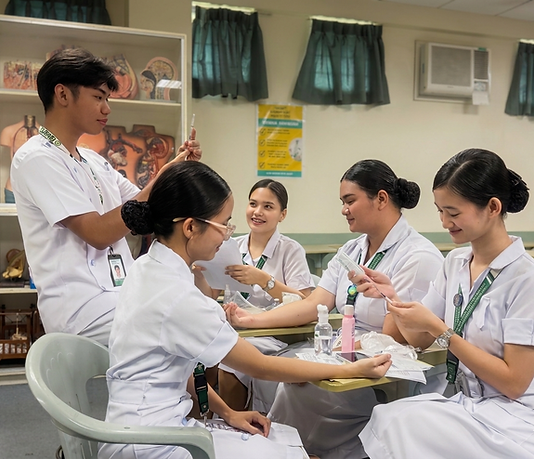
The NAL D Facility used for learning in nursing. The NAL D facility is a large classroom for big groups and presentations. It has comfortable chairs, whiteboards, a podium, and screens for teaching. The room is bright and cool because of the windows and air-conditioning, helping students stay focused. The Small Room is a flexible space for both studying and practicing skills. It has tables, chairs, and a whiteboard for discussions. It also has beds with curtains for privacy during nursing practice or simulations. This room helps students and staff easily switch from learning to hands-on activities.
MEDICAL-DENTAL CLINIC
The Clinic is an important facility that provides basic healthcare services to students and school personnel. It is usually managed by a school physician and dentist or trained health staff who are responsible for giving first aid, monitoring minor illnesses, and responding to health emergencies and dental check-ups. The clinic also plays a role in promoting health awareness by providing guidance on proper hygiene, nutrition, and disease prevention. It keeps basic medical supplies and equipment necessary for immediate care.
NURSING ARTS LABORATORY B (NAL B)
NAL B facility provides a complete learning environment that combines a lecture hall with realistic medical simulation rooms. The classroom is filled with rows of tablet chairs and organized study materials, making it a great space for group discussions and lectures. Just steps away, students can practice in specialized areas like the Nursery, Labor Room, Delivery Room, and PACU, which are designed to look exactly like a real hospital. There is also a dedicated washing area where students can learn essential hygiene and clinical protocols. This facility ensures that everyone gets both the classroom knowledge and the experience they need to succeed.
MIDWIFERY ARTS LABORATORY
(MAL)
MAL is a specialized classroom designed for both lectures and hands-on nursing study. The room features chairs, tables, television, and white board for studying and also this space students can clearly see demonstrations, while the other area has hospital beds, mannequins, and medical equipment for practicing clinical skills. Cabinets are stocked with training manuals and patient records, and educational displays are placed throughout the room to support lessons in anatomy and patient care. This combined setup allows students to immediately apply the theories they learn in class to realistic medical scenarios in one organized space.
GENERAL LABORATORIES
Laboratories are specialized facilities designed for conducting experiments and practical activities in various subjects. They are equipped with tools, equipment, and materials needed for hands-on learning. Laboratories allow students to apply theoretical knowledge and develop scientific skills. They promote critical thinking, observation, and problem-solving abilities. Proper supervision is maintained to ensure safety and effective use of resources.